

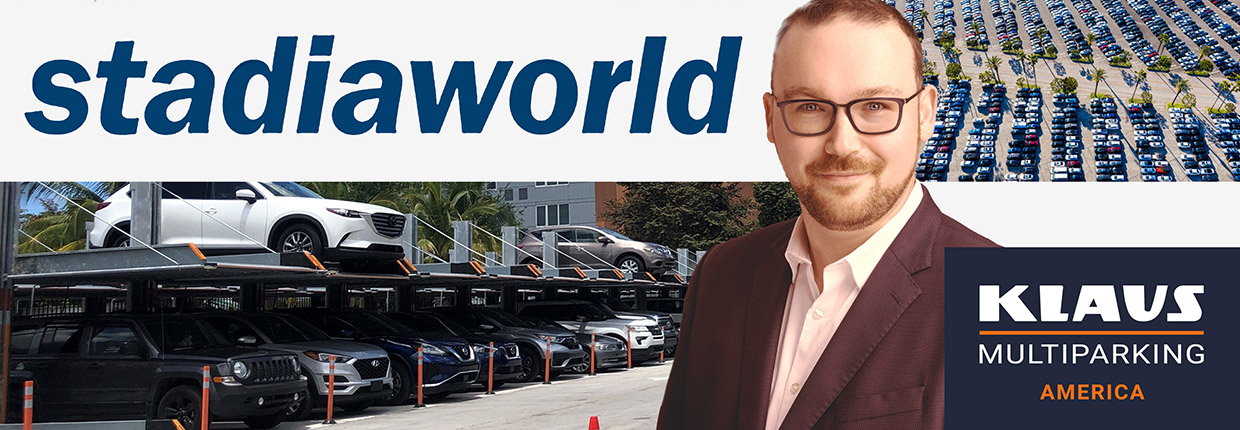
Stadium operators face a recurring dilemma: fans judge their experience based on excitement, comfort, and convenience, but many venues allocate their most valuable real-estate, often 8-10 acres for every 1,000 parking spaces, to static parking lots. That space comes at a steep opportunity cost. In an era when premium hospitality, retail, and mixed-use amenities are commanding high returns, traditional surface parking begins to look like wasted potential.
To quantify the trade-off: if a typical NFL stadium uses ten acres for a 1,000-space lot, that land could instead host high-margin premium amenities, luxury suites, dining terraces, branded entertainment venues, or hotel-style hospitality. If those facilities deliver double or triple the revenue per square foot of asphalt, the decision to commit land to parking becomes an economic one, not just operational.
Smart parking design offers a key solution. By adopting compact and high-density systems, such as two-high stackers, three-high stackers, or “no-pit” automated parking modules, stadia can reduce the footprint of parking by 30–50%. That frees valuable land adjacent to the stadium for revenue-generating uses, while maintaining or even improving parking capacity and flow.
A premium‐service differentiation also emerges when parking itself becomes an experience. Automated valet systems enable VIP ticket holders and corporate sponsors to park in seconds, without walking long distances, navigating ramps, or waiting in lines. These systems, stackers with valet integration, “no pit” puzzle lifts, and mobile-app controlled retrieval, allow venues to charge a premium for valet-style parking, enhancing fan satisfaction while unlocking new income. Imagine a scenario where the stadium’s valet deck is marketed not just as parking, but as part of the hospitality journey, pre-game lounge, in-vehicle refreshment, and rapid exit.
Handling the “surge factor” of crowds arriving and departing within compressed windows remains a major challenge in venue operations. Conventional parking lots often create bottlenecks: long queues, traffic conflicts, and fan frustration. Smart systems mitigate this through vertical stacking and horizontal shifting within the system itself, allowing vehicles to move efficiently in and out while requiring minimal land area and fewer access lanes. That improves throughput, enhances safety, and supports the fan experience while still delivering capacity. By moving unoccupied vehicles, the systems minimize idling and circulation, which in turn reduces CO₂ emissions and environmental impact.
Infrastructure adaptability is increasingly critical. The rise of electric vehicles (EVs), app-driven rideshare drop-offs, and premium mobility expectations mean parking operations must evolve. A compact, automated structure can integrate EV chargers, dynamic signage, valet-mode drop-off bays and modular expansion. For example, a two- or three-high stacker system can be designed so that one module can be converted into a charging lounge or micro-retail space in the future, transforming parking from a cost center into an asset.
For stadium decision-makers, the framework is clear: view parking not simply as a necessary service, but as a strategic real-estate driver. Key questions to evaluate include: what revenue per square foot is being foregone by conventional parking? What premium could valet style command? How many seats, hospitality units, or branded entertainment venues could fit on land reclaimed through compact parking design? How will mobility behavior evolve over the next 5-10 years, and is parking infrastructure flexible enough to adapt?
In reality, many venue operators behave as though parking is fixed. But when parking becomes movable, vertical, app-driven and integrated into the fan journey, it stops being a cost, it becomes a revenue engine. Introducing valet-enabled stackers, high-density modules or no-pit lifts adjacent to the stadium means fewer acres dedicated to asphalt, more land available for experiences, and a parking operation that enhances rather than drains value.
The business case is compelling: if reclaiming one acre of land allows installation of 15-20 premium hospitality suites or branded retail pods each generating significant profit, the impact on a venue’s annual revenue and balance sheet can be transformative. Coupled with improved circulation, shorter walk-times, faster exits and positive fan sentiment, parking design becomes a competitive advantage, not a silent liability.
In short, stadium parking needs a mindset shift. Rather than seeing it as an ancillary amenity, venue leadership must recognize it as a component of the real-estate portfolio. Modern parking systems, two-and three-high stackers, no-pit versions, and valet-enabled modules, are the practical tools that allow land-rich but capacity-limited campus layouts to unlock hidden value and elevate fan experience in one move.
Explore stadiaworld.com: https://www.stadiaworld.com/news/113029/smart-parking-design-unlocks-hidden-revenue-streams